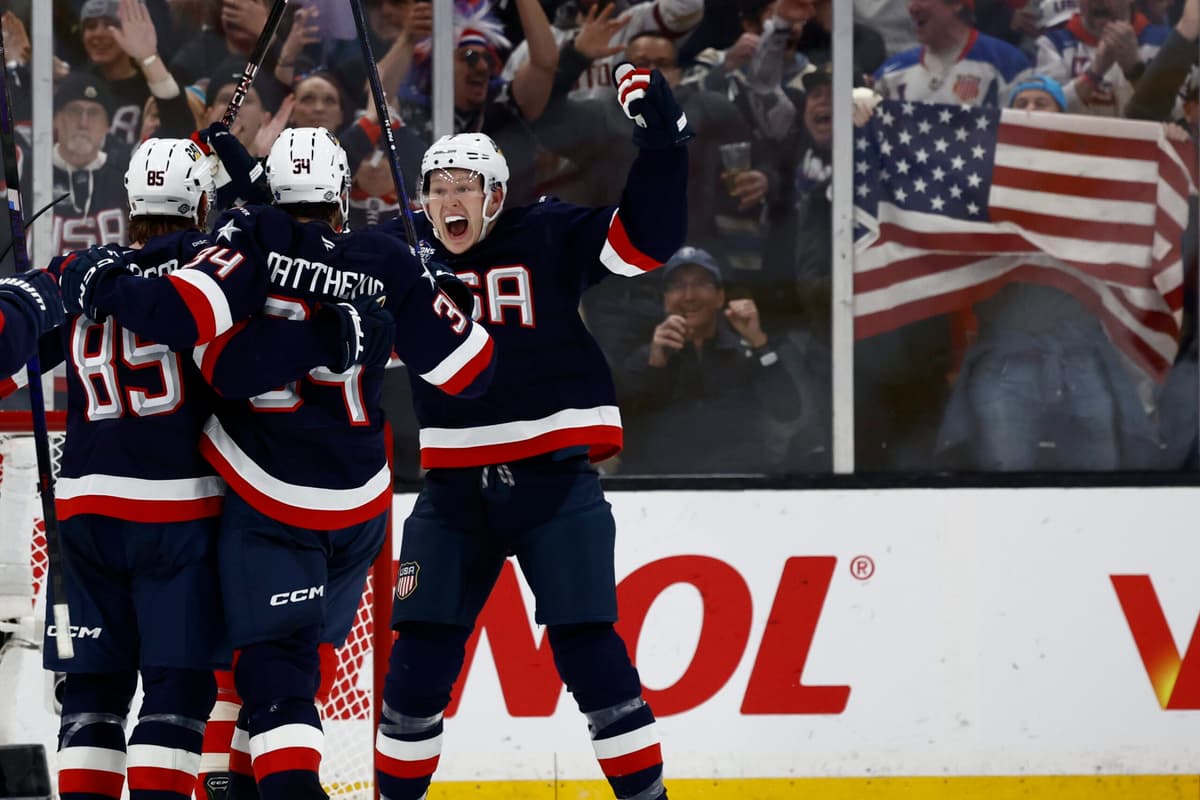
The 4 Nations Face-Off did more to drum up interest for pro hockey in the United States than anything else the NHL has tried in decades. Whether that’s an indictment of the league, an endorsement for the enduring appeal of best-on-best international hockey, or both, one thing is for sure: Americans want to see Team USA knock Canada from its perch atop the hockey universe.
The U.S. players will surely remember all the trash talk, bad blood, and rough stuff that took place during their 1-1 split with Team Canada at the 4 Nations. They’ll also remember that their northern cousins won the matchup that really mattered, just as they’ve won every best-on-best elimination meeting between the North American superpowers since the 1996 World Cup of Hockey.
Riding high from an IIHF World Championship triumph that featured five of its Olympic selections in key roles, Team USA is hellbent on making things right and cashing in on its deepest collection of talent since at least ’96. By regarding any potential victory over the Canadians as a prize on par with the gold medal (we’ve all seen the ad), are the Americans overlooking the potential threats posed by the Swedes, the Finns and a sneakily dangerous Group C?
Readers of a certain age will remember the post-amateur, pre-NHL Olympic landscape when American teams made up of kids who weren’t quite old enough and pros who weren’t quite good enough for NHL duty banded together for a months-long touring season in the hopes of arriving at the tournament as a true team.
After the NHL pulled its players from the 2022 Games at the last minute, Team USA iced a similar mix of collegiate players and European or AHL pros, except without the benefit of a lengthy exhibition season. Given the circumstances, the ragtag American team did well to finish first overall in group play, though disappointment awaited in the quarterfinal round; a veteran roster of bronze-medal-bound Slovaks tied the game at 2-2 with less than a minute left in regulation before knocking out Team USA in a shootout.
Though Matthew Knies and Matty Beniers may have gotten outside consideration for this year’s roster, defensemen Jake Sanderson and Brock Faber, who made the cut as teenagers back in ’22, will be America’s only repeat Olympians.
Ahead of the 4 Nations, there was a gathering buzz that the United States could take the gold simply by icing the best roster in the field. Sure, Team USA didn’t have a Leon Draisaitl or a Nikita Kucherov. Still, each of Auston Matthews, Matthew Tkachuk, and Jack Eichel was supposed to be close enough to that tier for the Americans’ superiority on the blueline and between the pipes to cover the difference. Considering the outrage that surrounded the omission of high-scoring wingers Jason Robertson and Cole Caufield, it’s fair to wonder where public confidence in an offensive core of Matthews, Tkachuk, and Eichel stands today.
Eichel has only gotten better since last February and seems likely to garner outside consideration for the Hart Trophy for the rest of his prime. Matthews, meanwhile, has only shown off his MVP best (he actually won the thing back in 2022) in fits and starts since his historic 69-goal outburst two seasons ago. His 46-goal pace since then isn’t exactly the mark of a plug, but Matthews’ injury woes and spotty big-game record have left his fans both stateside and in Toronto low on confidence that he can ever be the guy on a winning team, Olympic or otherwise. Tkachuk, on the other hand, is as proven a winner as there is, but he didn’t return from the muscular injuries he suffered at the 4 Nations until last year’s postseason, after which he received corrective surgeries that kept him out until last month. Is the famously grating power forward still the same player who dragged the Florida Panthers to the 2023 Stanley Cup Final? He’s racked up some hard miles in the meantime.
Elsewhere in the top six, Brady Tkachuk will line up opposite his brother on Eichel’s unit after his human pinball act last February endeared him to a nation (hint: not Canada). It’s less clear who Matthews will start with, but Jets winger Kyle Connor has the most offensive pedigree of any other American on the roster. If Connor once again struggles with the intensity of international play, coach Mike Sullivan won’t hesitate to push brawny two-way winger Matthew Boldy or clutch goal scorer Jake Guentzel up the lineup.
2024 Norris Trophy winner Quinn Hughes was sorely missed last February. He and Eichel will likely facilitate a power play that features Matt Tkachuk at the netfront, Matthews in the bumper, and the devastating one-timer of Sabres sniper Tage Thompson from the left circle. Roving D-man Zach Werenski’s dangerous point wrister could provide a different look for the unit if the initial configuration is a dud.
If Team USA GM Bill Guerin courted controversy by picking veteran penalty-killing forwards J.T. Miller, Brock Nelson, and Vincent Trocheck over Robertson and Caufield, not even his snub of 2021 Norris winner Adam Fox (twice) or Seth Jones’s injury can dim the optimism surrounding a deep, varied blueline.
The list of defensemen who are more dynamic than Hughes and Werenski begins and ends with Canada’s Cale Makar. Guerin must feel very clever now that his trade to bring Hughes to the Minnesota Wild has both given his NHL club a franchise player and his U.S. roster a turnkey top-four pairing; since arriving in the Twin Cities, the eldest Hughes brother’s connection with do-it-all local product Faber has forged one of the NHL’s best and busiest units. Faber’s offense has reached new heights (7 G, 21 P in 25 GP since trade) across from Hughes. The former’s leftover chemistry with Jaccob Slavin from the 4 Nations is not an adequate reason to mess with an even more natural fit.
Slavin, a favorite among hockey purists due to his elite stickwork and gap control, has already missed 40 games with various injuries; Sullivan will nonetheless call his number against the Draisaitls of the world. If ‘Sully’ wants to pair Slavin with another defensive dominator, the bench boss should consider using Slavin on his off right side next to Sanderson. Ottawa’s understated (well, usually) ‘Sand Man’ has been one of the most unbeatable defenders in the NHL this season (2.05 expected goals against per 60). Charlie McAvoy, Sullivan’s son-in-law and one of only two natural righties on the team, is also comfortable soaking up defensive zone starts. Amid a career-best offensive season, though, it could be more interesting to let McAvoy get out and skate in transition with Werenski, where McAvoy’s penchant for devastating open-ice hits could be particularly useful.
While it’s true the much-discussed selections of Miller, Nelson, and Trocheck were supposed to add some penalty killing utility and bottom-six jam, only Nelson is actually suppressing chances at the NHL level. Perhaps that’s just the difference between playing on the Rangers and the Avalanche, but if last year’s tournament is anything to go by, Dylan Larkin is Team USA’s true shutdown center. Larkin is accustomed to brutal matchups with Detroit and has the wheels to turn defense to offense in a hurry.
If the pre-eminence of the American goal crease wasn’t contingent on the Russians’ international ban in 2025, it certainly is in 2026. Reigning MVP Connor Hellebuyck won’t finish with any individual hardware this season; ‘Bucky’ has labored since returning from knee surgery in December (5-9-7, .892 SV% since 12/13) behind a bad Winnipeg team. You’d like Hellebuyck’s odds to bounce back behind a defense made up of Slavin, Faber, and four guys who are going to finish the year on Norris ballots. If Hellebuyck continues to struggle during the group play, though, perhaps against Germany’s underrated attack, will Sullivan consider a change?
Among the backups, Jake Oettinger is the high-floor play, but he’s more of an innings eater than a true dominator. Alaskan Jeremy Swayman, meanwhile, has been a game stealer at the center of the Bruins’ surprise playoff charge. Can Swayman’s dominant highs and World Championship success (7-0, 1.69 GAA, .921 SV%) overshadow his tendency to drop the occasional dud (8 games with 5+ GA, T-most)? That second part could become a real issue in the knockout round.
This is a big one for Mike Sullivan.
Well, duh, right? It’s the first “real” Olympic tournament in over a decade. For Sullivan, though, there’s also some pressure to prove he’s still got it. The Penguins, who had long gone stale since Sully led them to back-to-back Cups from 2016-17, have a real chance to make it back to the postseason in their first season with new beau Dan Muse. Sullivan’s punchless Rangers, meanwhile, are publicly waiving the white flag on their season.
There’s also the issue that, despite some inspired lineup decisions, Sullivan got outcoached by Canadian counterpart Jon Cooper in the 4 Nations final. Yes, Team USA was that close to victory, but Sullivan put his men at a severe disadvantage in overtime by shortening their bench to three lines much earlier in the game. In the lengthier Olympic format, it will be crucial for the future Hall-of-Famer to find a way to roll four productive units.
Is this Team USA’s last chance at Gold for the foreseeable future?
Let’s be honest with ourselves: the future is Canadian. Connor Bedard, Macklin Celebrini, Matthew Schaefer went first overall in consecutive drafts from 2023-25. All three of them are foundational, franchise players that will join up with Team Canada before Connor McDavid and Nathan MacKinnon’s primes are through. Celebrini already has.
The Americans, meanwhile, are plucking fewer stars from the ranks of the USNTDP than ever. Worse yet, they lost their already crumbling monopoly over the NCAA pipeline for good after CHLers started playing college hockey.
Team USA needs to cash in while Matthews, Tkachuk, Eichel, and that loaded blueline can at least come close to matching Canada’s star power in the aggregate; with respect to America’s next wave of Logan Cooley, Knies, and Lane Hutson, that might be an impossible task after another four years of development for Bedard, Celebrini, and Schaefer.
Team USA is worse now than it was 12 months ago. Matt Tkachuk is held together by bubblegum, duct tape, and a prayer. Hellebuyck has quickly lost his iron grip on the title of “best goalie in the world.” It’s tough to remember that last time we weren’t wondering, “What’s wrong with Auston Matthews?” Unforced errors in the selection process and a murky leadership picture (there isn’t a captaincy choice that wouldn’t raise eyebrows) won’t help. If they didn’t beat Canada in 2025, when Hellebuyck was in MVP form and Tkachuk’s muscles were still attached to their corresponding bones, what hope do the Americans have now that Team Canada has taken steps to improve in the bottom six and in goal?
After coming agonizingly close to cutting its hockey big brother down to size last February, the U.S. team now seems to occupy a tier in between Canada and everyone else. There’s always a chance they get goalie’d by Lukas Dostal (CZE) or Filip Gustavsson (SWE), but, since we all have our calendars cleared for a USA–Canada final anyway, let’s get hyper specific: Guentzel draws first blood, but goals by Reinhart, Makar, and, finally, McDavid keep things status quo in a 3-1 gold-medal game.
GOALTENDERS
Connor Hellebuyck (Winnipeg Jets)
Jake Oettinger (Dallas Stars)
Jeremy Swayman (Boston Bruins)
DEFENSEMEN
Brock Faber (Minnesota Wild)
Noah Hanifin (Vegas Golden Knights)
Quinn Hughes (Minnesota Wild)
Jackson LaCombe (Anaheim Ducks)
Charlie McAvoy (Boston Bruins)
Jake Sanderson (Ottawa Senators)
Jaccob Slavin (Carolina Hurricanes)
Zach Werenski (Columbus Blue Jackets)
FORWARDS
Matt Boldy (Minnesota Wild)
Kyle Connor (Winnipeg Jets)
Jack Eichel (Vegas Golden Knights)
Jake Guentzel (Tampa Bay Lightning)
Jack Hughes (New Jersey Devils)
Clayton Keller (Utah Mammoth)
Dylan Larkin (Detroit Red Wings)
Auston Matthews (Toronto Maple Leafs)
J.T. Miller (New York Rangers)
Brock Nelson (Colorado Avalanche)
Tage Thompson (Buffalo Sabres)
Brady Tkachuk (Ottawa Senators)
Matthew Tkachuk (Florida Panthers)
Vincent Trocheck (New York Rangers)
Feb. 12 vs. Latvia: 3:10 PM ET
Feb. 14 vs. Denmark: 3:10 PM ET
Feb. 15 vs. Germany: 3:10 PM ET
_____
POST SPONSORED BY bet365
_____