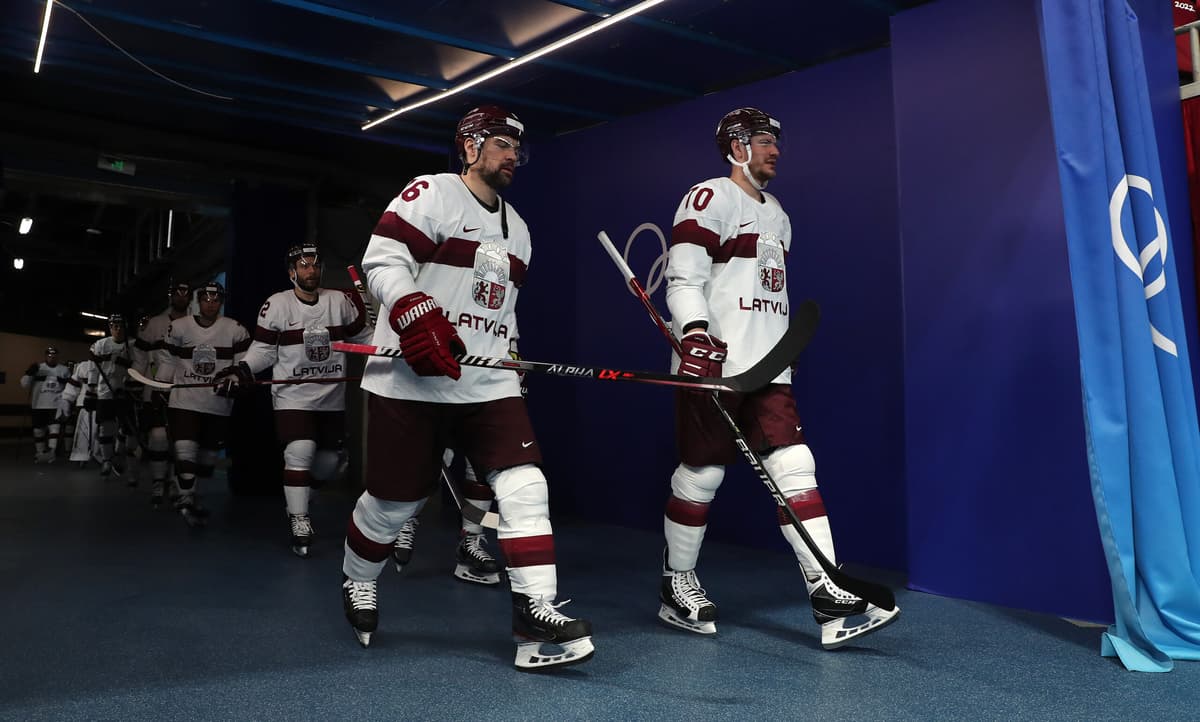
The Olympics haven’t typically been kind to Latvia.
The team has never finished better than eighth – the year they nearly beat Canada in the quarterfinal. The team qualified for the first time in 1936 and not again until 2002. In that time, they have finished last twice (2006 and 2010), and are coming off an 11th-place finish from 2022.
But since the last Olympic tournament, Latvia has won bronze at the 2023 IIHF World Championship. That event wasn’t enough to earn them an automatic bid to the 2026 Olympics, but they had no issue in the qualification event.
Latvia has built a reputation as being one of the pluckiest underdogs in international hockey. Could the 2026 Winter Olympics become their magnum opus?
Latvia had a tournament to forget in 2022. The team started with a 3-2 loss to Sweden (their best game of the event), before falling 3-1 to Finland and 5-2 to Slovakia. That left the Latvians in fourth in what turned out to be a stacked Group C, scoring just five goals in the round-robin and the 11th seed out of 12 teams heading into the qualification round.
Latvia would meet up with Denmark, a new team to the Olympic circuit, looking to make its own mark. The two teams traded goals in the opening 40 minutes, with Latvia even holding a 2-1 lead halfway through the game. Unfortunately, a power-play goal for the Danes prevented the Latvians from moving on, resulting in a disappointing 0-4 effort.
Scoring has never been Latvia’s forte at any tournament. But they’ve got a host of forwards who’ll grind you down and play a committed two-way game.
Teddy Blueger was injured back in October and only recently returned to Vancouver’s lineup. Fortunately for the Canucks, he’s tracking for just under 20 goals and 23 points, and has an 82-game pace of 55 points. Given his previous best output is 28 points, it’s unlikely that would have been sustainable (his 29.4 percent shooting percentage is kind of absurd). But Latvia will ride every second of that momentum with the team’s projected No. 1 center.
As for No. 2, Boston Bruins prospect Dans Ločmelis has been hovering around the top 10 in AHL scoring for most of the season. The former UMass standout has come a long way over the past few years, which included an outstanding performance at the World Championship last spring. Many scouts wondered if Ločmelis’s NCAA numbers would translate to AHL success, and he’s on track for just fewer than 50 points. So far, so good – and Latvia is going to love him as a multi-faceted scoring threat.
Tampa Bay’s Zemgus Girgensons competed in the 2014 Olympics and would have played a big role in 2018 and 2022 had NHLers been eligible. He is definitely not known for his offensive stylings, but he is projected to finish with more than 20 points for the first time in over a decade. Girgensons will provide veteran leadership and a big frame, likely in a middle-six role.
Florida Panthers prospect Sandis Vilmanis is more of a support player, forcing turnovers and blocking shots. On a team like this, Vilmanis can be a jack-of-all-trades – someone who can be a trigger man or who could kill penalties. Vilmanis has seen a bit of NHL action this year, primarily in a fourth-line role. The 22-year-old has only played a single game with the men’s team, but he was always a decent producer with the U-20 squad whenever called upon. His work ethic will definitely be useful, and he has some decent speed to boot.
Two other prospects with NHL affiliations are Eduards Tralmaks (Detroit) and Anri Ravinskis (Vancouver). Tralmaks had an excellent World Championship last spring, and has continued to get better as an overall offensive threat since he was originally part of Boston’s system in the early 2020s. Ravinskis, meanwhile, was a late injury addition to this team, but he’s physical and plays at a decent pace. Tralmaks will likely factor into the top six, while Ravinskis will likely be an energy forward.
The most prominent player without a current NHL affiliation is Rūdolfs Balcers. The veteran winger has typically played some great hockey internationally and is having a strong season with the Zurich Lions in Switzerland. Balcers has 62 points in 170 career NHL games, showing some versatility and solid two-way play. Look for him to factor into Latvia’s top six.
Even though Mārtiņš Dzierkals likely will never play in the NHL, Vegas owns his rights. He simply hasn’t produced well since heading to Europe over half a decade ago, but he’s still a skilled playmaker who can kill penalties and battle hard along the net. Renārs Krastenbergs will likely serve as a more skilled forward in Latvia’s bottom six, combining his speed and high compete level to win battles.
And then, there’s former NHL forward Kaspars Daugaviņš. Now 37, Daugaviņš currently plays in the second-tier German league, but he was excellent at the Deutschland Cup back in November. He’s definitely not the high-skill winger we once saw in the NHL, and he doesn’t play at the same pace he once did. But Daugaviņš has been a leader for Latvia internationally for quite some time and will likely give it his all in the bottom six in what should be his final Olympic appearance.
Is it a strong group up front? No. Can they wear you down? Absolutely. They’re going to need some heroic performances up front to do any real damage, though.
This is typically where the Latvians shine. Latvia’s blueline features a mix of international hockey’s most seasoned blueliners and, funny enough, the youngest player in the tournament, Alberts Šmits. NHL scouts will be keeping a close eye on the 18-year-old defenseman. That’s because he has thrived against men in the top Finnish league, showing a high degree of hockey sense, mobility, and the ability to maximize his 6-foot-3 frame. It’s likely he’ll start the tournament in more of a depth role (he has cooled off a bit since the World Juniors). But he’s arguably the most skilled defender the team has and could push higher up.
As for the veterans, the top defender is easily Uvis Balinskis. He didn’t see much playing time during Florida’s run to the Stanley Cup last year, but his ice time this year has bloomed to 16:06 from 14:51 a season ago. He’s physical, blocks a lot of shots and is typically solid defensively, even if he isn’t all too flashy. Balinskis will be counted on to play well north of 22 minutes a night, something he hasn’t done in the NHL. But as the lone big-league defender out of Latvia, he’ll be counted on heavily.
His NHL career might have been brief, but Kristiāns Rubīns skated in three games with the Toronto Maple Leafs back in 2021-22. He had a solid AHL career before heading over to Europe, where he currently plays with HC Plzen in the top Czech league. Injuries have limited him to just seven games so far, but he found himself playing more than 20 minutes a night almost immediately. Rubins has typically been solid internationally for Latvia, showing some solid chops as a puck-mover who can take up space with his big 6-foot-5 frame.
Jānis Jaks is on track for just under 30 points in the Czech league, marking one of his best pro seasons to date. Beyond the numbers, though, there’s a lot to like. He can play the power play, moves the puck well and is absolutely fearless. He’s not huge, but he’s strong and mobile. For a bit more size, Roberts Mamčics is massive at 6-foot-5, and his game is all about pure defense. You won’t notice him much unless he’s trying to kill you – something that seems to happen quite frequently.
The rest of the D-corps features familiar names. Ralfs Freibergs is getting up there in age, but he’s still moving well and has nearly 20 years of international hockey experience. Kristaps Zile blocks a lot of shots and tends to do well at simply getting in the way. Oskars Cibuļskis can play some decent shutdown hockey, but he’s no slouch as a playmaker, either. This blueline might lack star power, but they have plenty of size, experience, and chemistry from skating together so frequently over the past half-decade. Expect them to be busy.
Artūrs Šilovs or Elvis Merzļikins? Youth vs. experience? Both started strong this season, only for their surface numbers to fall a bit flat. Šilovs boasts the better 5-on-5 goals saved above expected at 3.05. It’s not the end-all, be-all stat, but Šilovs’ rating is significantly better than Merzļikins’ -1.37. Merzļikins has been better recently as the Columbus Blue Jackets have started to rise in the standings, so it’ll be interesting to see where the Latvians go here.
Both keepers have a strong past with the national team. Šilovs was outstanding at the 2023 World Championship, going 7-3 with a .921 save percentage en route to top goalie and MVP honors. He’ll forever be remembered as the goalie who led Latvia to its first medal in any major competition. It feels like Latvia will go with him as their No. 1, especially after watching his mega performance in the Calder Cup playoffs last year.
But Merzļikins is the seasoned veteran, one who has been through the trenches internationally. He struggled in his past two World Championship appearances but has represented the nation since 2010. He’s more than capable of stealing a game or two, something he’d have to do if Latvia were going to surprise anyone. For now, though, it feels like Šilovs should at least get the No. 1 gig to start.
And then there’s Kristers Gudļevskis – the man who nearly led Latvia to an unthinkable victory over Canada back in 2014. Gudļevskis would go on to play parts of three games with Tampa Bay but was never able to leverage that into anything more. He currently plays in the German DEL, where he has been quite good over the past three seasons. He even tended the starter’s net at the World Championship last year for just the third time in his career last year. At this point, though, Gudļevskis isn’t expected to play as the team’s No. 3 goalie.
On the surface, Latvia lacks a true game-changer in net. But that’s what they thought ahead of the playoff round in 2014 and again when they trusted an AHLer to lead them to a medal in 2023. As long as the goaltending doesn’t completely collapse, this shouldn’t be a concern.
Harijs Vītoliņš was selected twice in the NHL draft – first in 1988 by Montreal and again by Winnipeg in 1993. He only played eight NHL games but would go on to represent Latvia internationally throughout his pro career, including during the 2002 Olympics. Vītoliņš has served as the men’s national team coach since 2021-22, starting with the Winter Olympics. In all, this will be his fifth Olympics as a coach in some capacity, which includes gold as an assistant with Russia in 2018. Between that and bronze in 2023, Vītoliņš is as experienced as they come, and he knows this lineup inside and out.
Who’s going to score?
Some of the other backmarker teams, such as Germany (Tim Stutzle), Slovakia (Juraj Slafkovsky) and Denmark (Nikolaj Ehlers) have NHLers with high-end, top-line experience. Latvia doesn’t, and that could haunt them. Even when Latvia took home bronze, Daugavins was the lone player with more than five points and the only forward with more than two goals.
That’s not going to cut it when it really matters. Latvia needs someone to step up and take control, whether that’s a red-hot Bļugers or Ločmelis. They won’t get much offensive help from the point (Mamcics has a good shot, though), so they’ll need to get creative around the net. It just seems like an uphill battle for them, though.
By all accounts, this is a more dangerous unit than the one Latvia sent in 2014 when NHLers were last eligible. There’s a solid mix of NHLers and veteran skaters, with a pair of NHL goaltenders to boot. But it’s going to be a difficult round-robin for Latvia, which will begin the tournament against the United States. Both Germany and Denmark look better on paper, but both of those games should be incredibly competitive. Win both, and they’re in good shape. Win one, it’s manageable. Either way, they’re going to need a favorable opponent in the qualification round. Then that’s when Latvia can really hunker down and shut teams down. Latvia has become one of the better underdog teams at the men’s level in recent years, so look for them to at least qualify for the quarterfinal.
GOALTENDERS
Kristers Gudlevskis
Elvis Merzļikins (Columbus Blue Jackets)
Artūrs Šilovs (Pittsburgh Penguins)
DEFENSEMEN
Uvis Balinskis (Florida Panthers)
Oskars Cibuļskis
Ralfs Freibergs
Jānis Jaks
Roberts Mamčics
Kristiāns Rubīns
Alberts Šmits (2026 NHL Draft)
Kristaps Zīle
FORWARDS
Rūdolfs Balcers
Oskars Batņa
Teodors Bļugers (Vancouver Canucks)
Rihards Bukarts
Roberts Bukarts
Kaspars Daugavins
Mārtiņš Dzierkals (rights owned by Vegas Golden Knights)
Haralds Egle
Zemgus Girgensons (Tampa Bay Lightning)
Renārs Krastenbergs
Dans Ločmelis (Boston Bruins)
Anri Ravinskis (Vancouver Canucks)
Eduards Tralmaks (Detroit Red Wings)
Sandis Vilmanis (Florida Panthers)
Feb. 12 vs. United States: 3:10 PM ET
Feb. 14 vs. Germany: 6:10 AM ET
Feb. 15 vs. Denmark: 1:10 PM ET
SPONSORED BY bet365
Hockey News